Dagger
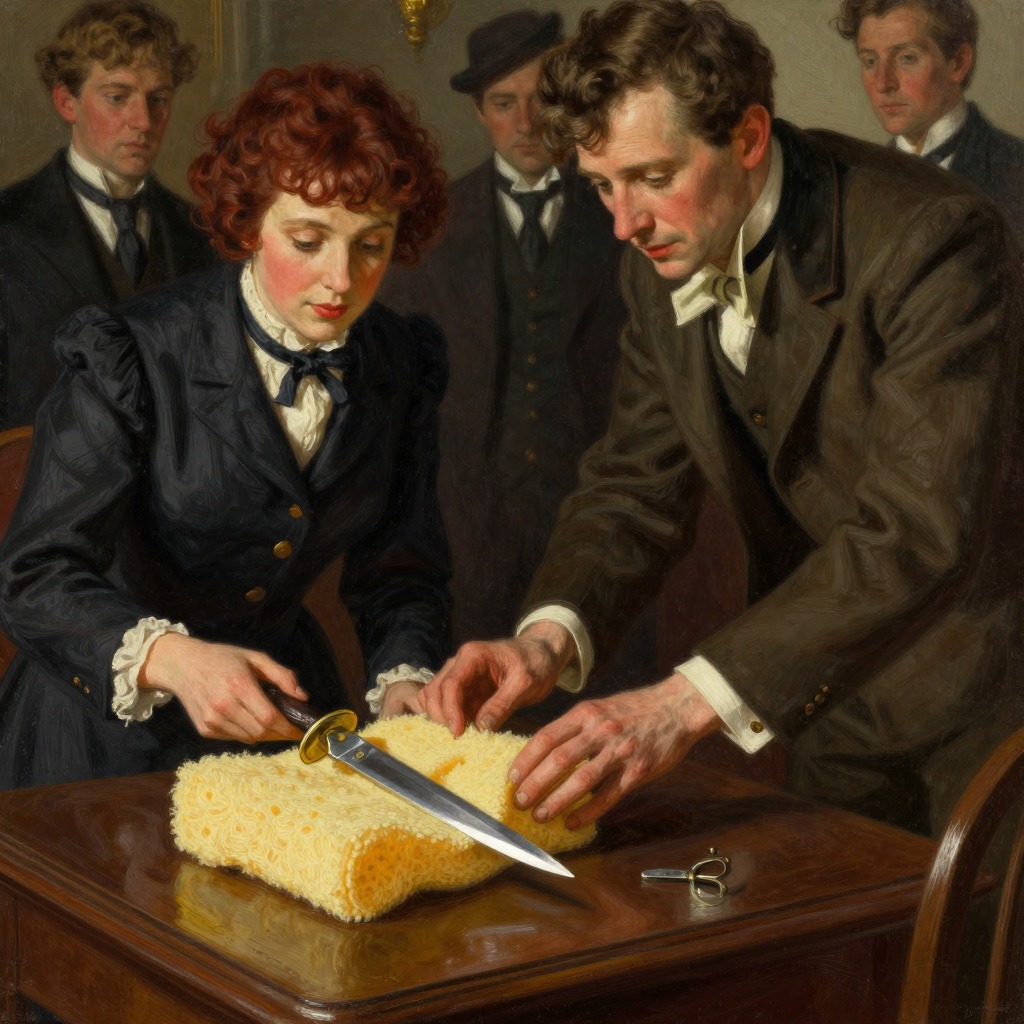
The dagger that killed Samuel Edward Ratchett was a cheap, sham Oriental weapon—a straight-bladed knife with an embossed hilt and a tapering blade, of a type mass-produced and shipped to the bazaars of Constantinople. It was discovered not beside the body but in Mrs. Hubbard's sponge-bag, hanging on the handle of the communicating door between her compartment and Ratchett's. The blade was stained with patches that looked like rust but were in fact blood. When Dr. Constantine examined it, he confirmed that it could account for any of the wounds on the victim. Yet the weapon's very ordinariness and its theatrical placement—a cliché of detective fiction—immediately struck Poirot as suspicious, part of a deliberately staged scene rather than a genuine oversight.
Discovery and Initial Significance
The dagger came to light when Mrs. Hubbard, having been moved to a new compartment after the murder, opened her sponge-bag and found the knife inside. She burst into the dining-car screaming, "It's too horrible! In my sponge-bag. My sponge-bag! A great knife—all over blood?" and fainted on M. Bouc's shoulder. Poirot, M. Bouc, and Dr. Constantine hurried to her original compartment, where the conductor had left the sponge-bag hanging on the door handle. Poirot picked up the dagger delicately, noting that there would be no fingerprints on it save those of Mrs. Hubbard herself. Dr. Constantine's examination confirmed it was the murder weapon, but Poirot immediately saw a problem: "Already we are heavily overburdened by coincidence. Two people decided to stab M. Ratchett last night. It is too much of a good thing that both of them should select the same weapon." The doctor pointed out that thousands of such daggers were made and shipped to Constantinople, so the coincidence was less remarkable than it seemed.
The Wounds and the Conspiracy
The dagger's wounds told a contradictory story that no single assailant could explain. Dr. Constantine found twelve wounds in total, some so slight as to be practically scratches, while at least three were deep enough to cause death. Several blows were delivered with such force that they drove through hard belts of bone and muscle, suggesting great strength; others were feeble and glancing. One wound under the right arm near the shoulder was almost certainly struck with the left hand, while other blows were just as obviously right-handed. The doctor concluded that the victim was already dead—some little time dead—when two of the deepest wounds were inflicted, because the edges did not gape and had not bled as expected. Poirot summarized the absurdity: "The murderer was a man of great strength—he was feeble—it was a woman—it was a right-handed person—it was a left-handed person." This impossibility forced him to consider that more than one person had used the same dagger, each striking in turn.
The Weapon as a Clue to the Conspiracy
The dagger's cheap, mass-produced nature and its placement in the sponge-bag were not mistakes but deliberate choices in a carefully orchestrated plan. Poirot realized that the twelve wounds corresponded to the twelve passengers in the Stamboul-Calais coach, each of whom had a connection to the Armstrong family tragedy. The weapon was chosen because a dagger could be used by anyone—strong or weak—and made no noise. Each person entered Ratchett's darkened compartment through Mrs. Hubbard's and struck, never knowing which blow actually killed him. The dagger was then thrust into the sponge-bag in passing, a detail that Linda Arden, playing the role of Mrs. Hubbard, later admitted was a mistake: "That slip about the sponge-bag was silly. It shows that you should always rehearse property." The weapon, far from being a random clue, was the physical embodiment of the collective vengeance—a jury of twelve carrying out a sentence that American justice had failed to deliver.